
At a time of year when many people are debating the size of turkey and how many sprouts they’ll need for Christmas dinner, there are thousands more that are struggling to eat at all.
There has been a sudden, rapid growth in the number of foodbanks and supermarket ‘food collection points’. You could be forgiven for thinking that food poverty is a new problem. The truth is rather different; food, or rather a lack of it, has been a growing issue since the nineties, when the first Trussell Trust foodbank was founded by a couple in Salisbury operating out of a shed at the end of their garden.

It would seem that whilst bringing the problem to people who were previously unaware of the poverty crisis happening around them, the appearance of both foodbanks and strategically placed food collection points suggests a ‘normalisation’ of food aid for the future, according to Manchester expert, Dr Kingsley Purdam.
Dr Purdam, along with two colleagues at the University of Manchester, has written an in-depth report entitled ‘Hungry Food Stigma’; it makes both interesting and worrying reading to say the least.
The research, conducted in the North West, took into consideration evidence from a survey, case studies of foodbanks in the area and interviews with foodbank users. In this one city alone there are seven Trussell Trust foodbanks, and a further thirty other ‘free food providers’ in the area.
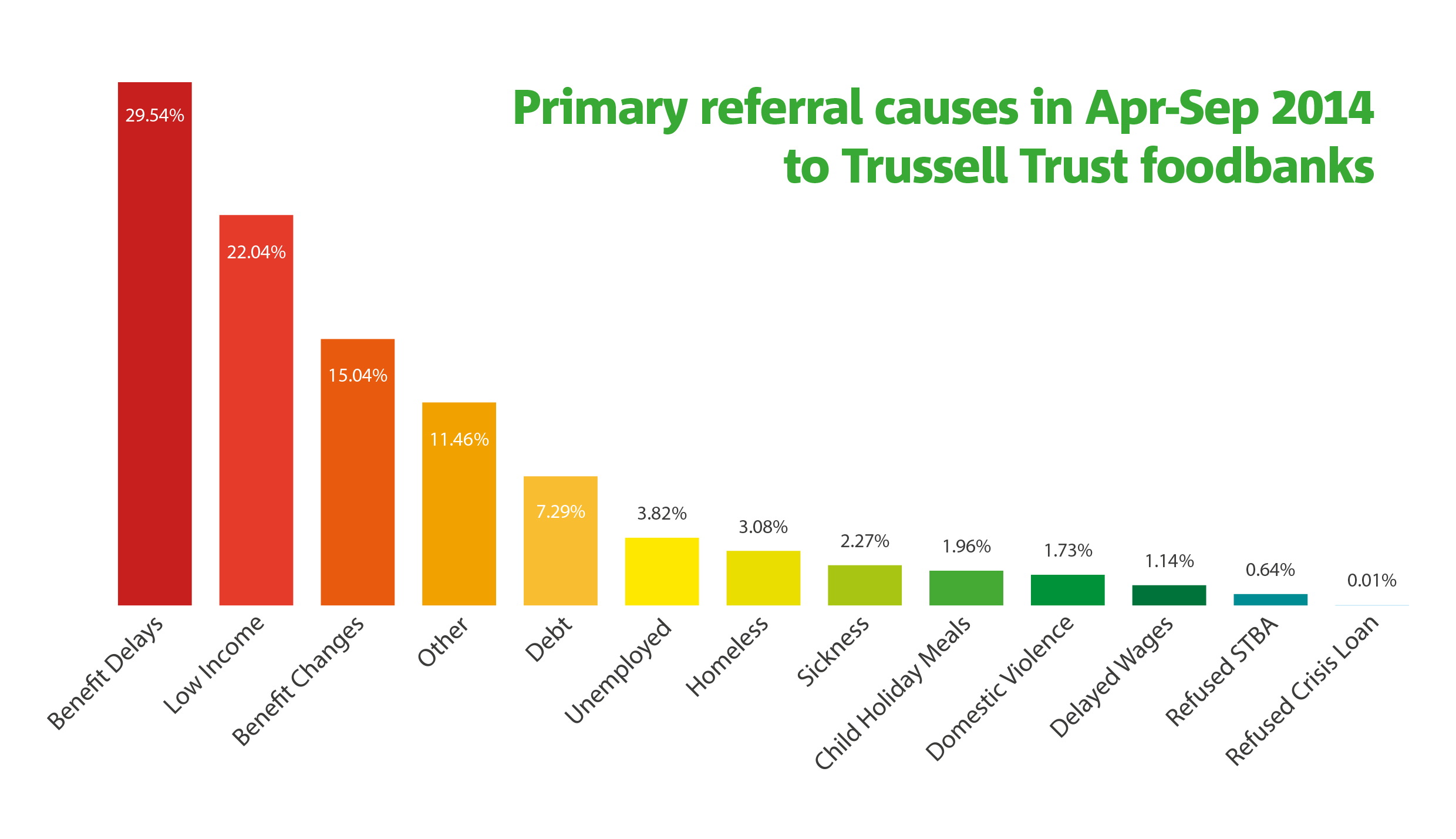
The Trussell Trust are opening foodbanks at a rate of two a week. Their figures reveal that the number of people they gave emergency food to rose from almost 350,000 in 2012/13 to over double at 900,000 in 20013/14. If this is the tip of the iceberg, as both the figures and Dr Purdam’s research support, then we have a huge problem and it is only going to get worse – it’s estimated that 4.7million people in the UK live in food poverty and the Trussell Trust predict there will be more than one million people using their foodbanks in 2014 alone.
This is without taking into consideration the many independent foodbanks and other informal sources of food aid that often go undocumented and rely heavily on both community support and donations.
The reasons people turn to foodbanks varies massively and, contrary to what some public figures would have you believe, it’s not because ‘poor people don’t know how to cook.’
While Baroness Jenkin has apologised for her comment, putting it down to ‘stupidly speaking unscripted’, she is not the first to make such a sweeping generalisation – former Conservative Government Health Minister Edwina Currie seemed to blame foodbank users themselves, stating that “they never learn to cook…the moment they’ve got a bit of spare cash they’re off getting another tattoo.”
Katie Hopkins has also jumped on the blame train, comparing foodbank users to ‘cancer patients’ in a recent outspoken rant on social media while Rachel Johnson, sister of the Mayor of London reportedly compared them to animals, saying “Apart from the telly and the cigarettes, they are living like animals.”
The language used to describe foodbank users seems located in a discourse of blame when in reality most people turn to them as a last resort and not as a way to ‘save a few quid’.
Linda from Sale, Manchester was forced to use her local foodbank after being sanctioned by the job centre, having her benefits suspended for several weeks. She says, “I don’t know what I would have done without the foodbank. When the job centre stopped my money for missing an appointment because my daughter was ill I had nowhere else to turn to get food for me and the kids. They were really friendly but the food they gave us was supposed to last for three days but I was sanctioned for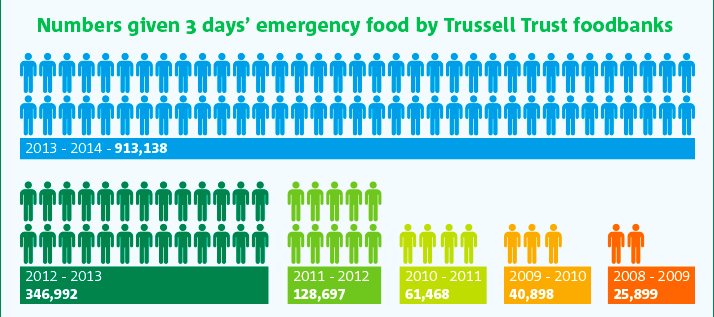 three weeks. Without the food from them and other friends we would have starved.”
Dr Purdam’s research found that in one North West city there were seven Trussell Trust foodbanks and one being set up, with thirty other food aid providers. It’s clear from this that any estimate of food aid use based on Trussell Trust data is likely to be a huge underestimation.
The study also shows that, contrary to public perception, the most common reason given for visiting a foodbank was benefit sanctions, followed by delays in benefit payments – it seems that this underlying issue is a major cause for concern and must be addressed as part of the food crisis debate.
Many of the people Dr Purdam’s research team spoke to described a sense of desperation and need that led to them going to a foodbank, one female visitior said that she “felt like she was begging whilst waiting for her pension credit” and another said she was “willing to turn to prostitution if she did not get help from the foodbank.”
For many people using foodbanks the impact of changes in benefits and entitlement had created a family crisis, this included the Spare Room Supplement or so-called bedroom tax introduced in 2013. Other foodbank users highlighted how recent difficulties and relationship breakdown had contributed to their financial difficulties. Whatever the case it’s clear to see that food poverty is a growing problem in both Manchester and further afield.
A key policy debate resulting from Dr Purdam’s research relates to the role of the state, the voluntary sector and commercial organisations in addressing food poverty in the UK, and the role citizens can have in ensuring their own welfare.
Perhaps there is some inevitability about the scale of food insecurity in the UK, given the impact of the economic recession and present welfare reforms but whilst the local authority has provided some funding, food aid is still predominantly reliant on volunteers and donations.
This, along with the ‘normalisation’ of food aid with foodbanks on the high street and food collection points common in supermarkets, are issues that cannot be ignored any longer and will require us all to pull together to make a difference.
Now is also a good time to consider how food waste and reuse is regulated in the UK, compared with other countries – in the UK it’s estimated that 15 million tonnes of food are wasted each year.
With some planning and communication there’s no doubt that some of this waste could be avoided and the government needs to step up and ensure access to adequate food for all. What can be termed as ‘the localization of food welfare’ is actually nothing more than a way of brushing it under the carpet or passing the buck.
Food poverty is an issue that affects us all and needs addressing urgently although sadly it’s clear that the financial vulnerability of certain populations is embedded far beyond the temporary fix of a food parcel.



 Small Girl in a Big World