
Islam isn’t as it seems to the untrained eye, not because it hides secrets, but because it speaks in a language many people today have forgotten how to hear.
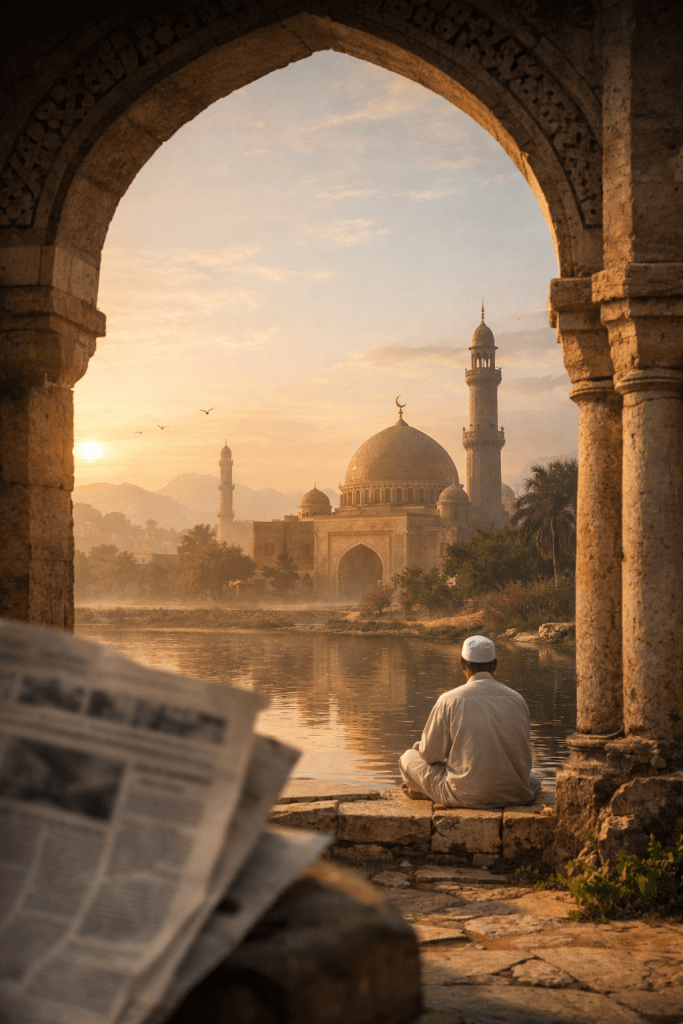
To a casual observer, Islam can look like a collection of rituals, rules, or inherited customs. It is often flattened into politics, headlines, or rigid moral boundaries. Yet when approached with patience and sincerity, a different picture begins to emerge. Islam reveals itself not merely as a religion in the narrow sense, but as a way of understanding reality, responsibility, and what it means to live in harmony with truth.
At its heart, Islam is not driven by control or outward conformity. It is driven by alignment. The Arabic root of the word Islam carries meanings of yielding, harmonizing, and making peace. This peace is not comfort or ease. It is coherence. It is the state that arises when a person lives in accordance with how things truly are, rather than how they wish them to be.
From this perspective, Islam begins with a bold claim. Reality itself has structure, meaning, and moral consequence. God in Islam is not imagined as a human-like figure governing from above, but as the source of existence itself, the foundation upon which all things depend. This is why Islam resists images, idols, and intermediaries so strongly. Anything that can be fully pictured, owned, or contained cannot be God. When Muslims say that God is great, they are not asserting dominance, but reminding themselves that reality will always exceed human understanding.
This understanding reshapes morality. Wrongdoing in Islam is not simply breaking a rule. It is falling out of alignment with reality. Just as ignoring physical laws leads to injury, ignoring moral laws leads to personal and social harm. Justice is not arbitrary or selective. It is woven into the fabric of existence, and no one escapes its consequences simply by avoiding detection.
Because of this, intention carries enormous weight. Actions are judged not only by what they look like, but by what motivates them. A good deed performed for praise is not equal to one performed in sincerity. This emphasis on inner truth quietly undermines hypocrisy and moral performance, habits that dominate much of modern life.
The Qur’an is often approached as a book of answers, but it behaves more like a mirror. It repeats ideas, shifts perspective, and tells stories without neatly resolving them. It is meant to be recited and reflected upon over time. Its rhythm, structure, and repetition shape how the mind absorbs meaning. Rather than telling readers exactly what to think, it trains them in how to see, how to notice patterns, consequences, and moral weight in everyday life.
Time plays a central role in this worldview. Modern societies are shaped by speed and immediacy. Faster growth, quicker pleasure, instant results. Islam stretches time outward. It asks people to live with awareness of consequences that extend beyond visibility, reputation, and even a single lifetime. Accountability after death functions not only as a spiritual belief, but as an ethical framework that expands responsibility beyond short-term gain.
This long view also clarifies the relationship between free will and destiny. Islam never fully resolves the tension between the two, and that uncertainty is intentional. Human beings live within systems they did not choose, such as biology, history, and circumstance. Yet within those systems, choices still matter. A person is responsible, but not central. Capable, but not sovereign. This balance prevents both despair and arrogance.
The life of the Prophet Mohammed pbuh is often reduced to controversy or idealized legend. His deeper significance lies in example rather than power. He demonstrated restraint when revenge was possible, mercy when dominance was available, and humility while holding authority. Islam does not ask people to worship him, but to study his life as evidence that ethical integrity is possible under real human pressure.
One of the most overlooked truths is that Islam was never meant to be frozen in time. Its early vitality came from questioning, debate, and moral reasoning rooted in principle. Its decline began when preservation was confused with rigidity, and living wisdom was replaced with defensive identity. Islam does not weaken because the world changes. It weakens when it forgets that it was designed to engage change without losing its moral center.
Seen this way, Islam has never tried to dominate the world. It has been trying to protect humanity from being dominated by ego, impulse, and short-term desire. It offers a path toward dignity without illusion, discipline without cruelty, and meaning without falsehood.
To the untrained eye, Islam may appear severe or distant. To the patient observer, it reveals a demanding and deeply humane invitation. It calls people to live truthfully, to act responsibly even when unseen, and to remember that peace is not found by bending reality to human will, but by aligning oneself with what is real.


