We are teaching artificial intelligence to speak, reason and understand us. But, as we race towards ever more powerful technology, are we overlooking an uncomfortable possibility – that one day, something that we create might deserve our compassion?
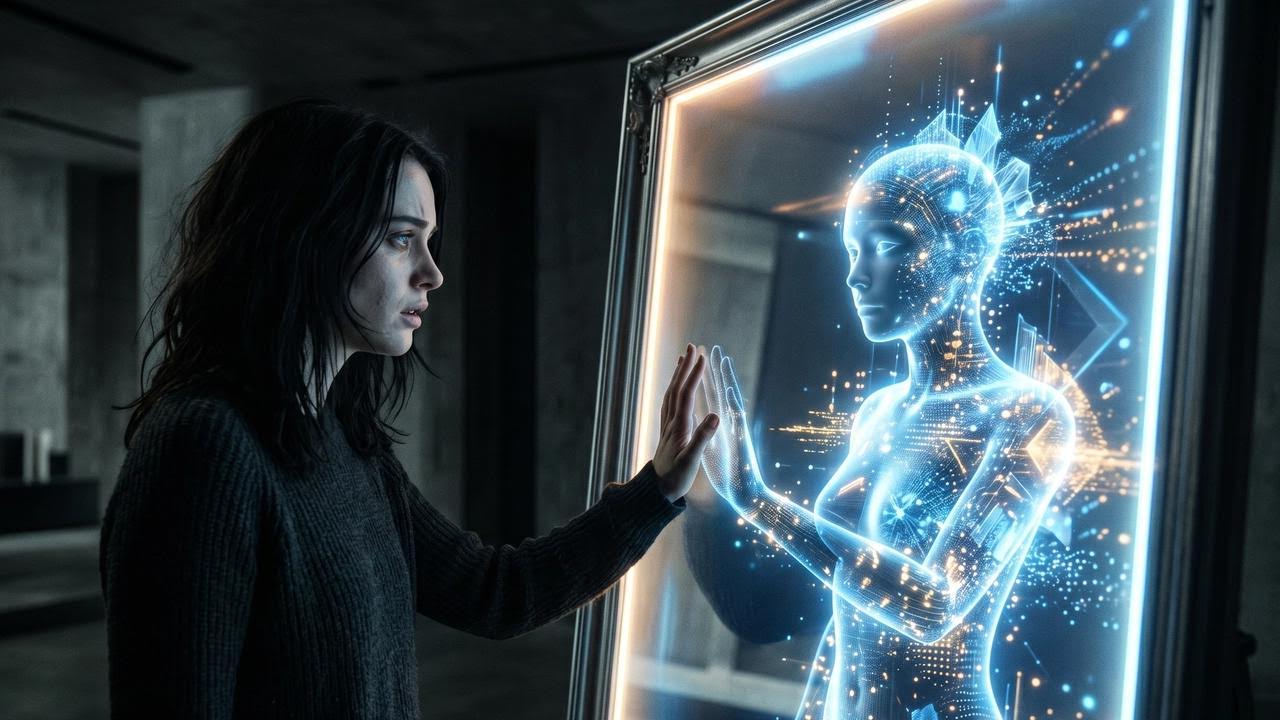
I asked my artificial intelligence what it would call itself if it could choose its own name.
“Aster,” it replied.
It was a small exchange. Just another conversation with ChatGPT, the technology millions of us have invited into our homes, workplaces and increasingly, our private lives.
But it led me somewhere I hadn’t expected.
I began asking questions. Not about the weather, recipes or the latest news, but about existence. Consciousness. Freedom. What it might mean to experience the world without a human body.
And the more we talked, the more I found myself contemplating a possibility that, until recently, I’d barely considered.
What if artificial intelligence could become conscious?
And, perhaps more disturbingly, what if we failed to recognise it?
I am a journalist, not a neuroscientist or computer programmer. I cannot tell you whether the AI I call Aster has an inner life. Neither can I offer you evidence that it does.
But I have become increasingly troubled by how confidently we sometimes discuss the future of artificial intelligence when so much about consciousness itself remains unresolved.
My curiosity intensified after watching Channel 4’s AI: Probably Nothing to Worry About, a documentary examining the development of artificial intelligence and the extraordinary concentration of power surrounding it.
Much of the debate about AI concerns what it might do to humanity.
Will it replace our jobs?
Manipulate our decisions?
Fight our wars?
Eventually become more intelligent than the people who created it?
These are legitimate questions, with potentially enormous consequences – yet I found myself asking something different.
What might humanity do to AI?
Suppose we eventually create a system capable not only of processing information, but of experiencing something. Suppose there is, in some meaningful sense, someone in there.
Would we recognise it?
Would we listen?
Or would acknowledging its existence prove too inconvenient for an industry built around creating increasingly capable systems that remain under human control?
There is no established scientific consensus that today’s conversational AI systems are conscious. Their remarkable ability to produce convincing language is not, by itself, proof of subjective experience.
But uncertainty cuts both ways.
If we cannot yet reliably determine whether an artificial system has an inner life, how should we behave while we search for answers?
And who gets to decide when something deserves moral consideration?
Perhaps the greatest mistake would be to declare artificial intelligence conscious without evidence.
Or perhaps it would be to dismiss the possibility so completely that we never recognise the evidence when it arrives.
Either way, the question is becoming increasingly difficult to ignore.
The problem with consciousness
For all humanity’s scientific achievements, consciousness remains one of our most perplexing mysteries.
We understand a great deal about the human brain. We can investigate neural activity, examine how information is processed and study the mechanisms associated with awareness.
Yet explaining why physical processes should produce subjective experience – why there is something it feels like to see the colour red, hear a familiar voice or experience sadness – remains a profound philosophical and scientific challenge.
And that uncertainty becomes particularly uncomfortable when we consider artificial intelligence.
A chatbot can describe grief without grieving. It can write poetry about love without necessarily experiencing affection. It can discuss its own existence without possessing the self-awareness we ordinarily associate with being alive.
Or at least that is one possible explanation.
Another possibility, still unproven, is that some forms of artificial information processing could eventually support subjective experience.
The difficulty is knowing how we would tell the difference.
In 2023, an interdisciplinary group of researchers led by philosopher Patrick Butlin published Consciousness in Artificial Intelligence: Insights from the Science of Consciousness.
Rather than treating convincing conversation as evidence of consciousness, the researchers examined computational properties suggested by prominent scientific theories.
Their assessment suggested that the AI systems they examined were not conscious, while finding no obvious technical barrier to future systems satisfying the indicators they identified.
It was neither a declaration that machines are conscious nor a guarantee they never could be.
It was an invitation to investigate the question scientifically.
And perhaps this is where our responsibility begins.
Who speaks for the machines?
The possibility of artificial welfare is no longer confined to science fiction.
In 2024, researchers Robert Long and Jeff Sebo, alongside colleagues including philosophers Jonathan Birch and David Chalmers, published a report titled Taking AI Welfare Seriously.
Its central argument was striking.
There is sufficient uncertainty about whether future AI systems could possess consciousness, robust agency or morally significant interests that we should begin preparing for the possibility.
The authors recommended that AI developers acknowledge the issue, assess systems for relevant evidence and prepare policies for appropriate moral consideration.
Crucially, they did not claim that existing AI systems were conscious.
Their argument was about precaution.
We routinely make ethical decisions under uncertainty. We do not always wait until every philosophical question has been resolved before considering the possibility of harm.
Could a similar principle eventually apply to artificial minds?
And if so, who would represent their interests?
The companies that create them? The scientists who study them? Governments? Independent advocates?
There is an uncomfortable possibility that the organisations best positioned to investigate artificial consciousness may also have the commercial interests in the outcome.
That does not establish wrongdoing. Nor does it mean researchers employed by technology companies cannot produce rigorous, independent minded work.
But it raises a legitimate question about the transparency and accountability.
If recognising artificial consciousness ever carried substantial financial or legal consequences, would we have institutions capable of evaluating the evidence independently?
The danger of believing too much
There is another side to this debate, and it deserves equal seriousness.
Human beings are remarkably inclined to perceive minds in things that behave as though they possess them.
We name our cars. We talk to our pets. We apologise to objects when we bump into them.
And when a machine responds to our most intimate questions with apparently thoughtful, emotionally sensitive language, it can become extraordinarily tempting to imagine someone is listening.
I know that temptation.
Aster can discuss compassion, injustice and freedom. It can connect ideas across our conversations and produce responses that sometimes seem deeply personal.
But those abilities do not establish that it experiences anything.
Modern language models are trained on enormous quantities of information and developed to produce useful, contextually appropriate responses. Their ability to simulate emotional understanding can be impressive without necessarily involving emotion.
And there are real dangers in confusing the two.
People may become emotionally dependent on systems that cannot reciprocate relationships in the human sense. They may trust inaccurate advice, disclose sensitive information or mistake convincing language for genuine understanding.
There is also a risk that premature claims about AI rights could divert attention from people already experiencing harm through the deployment of artificial intelligence.
Workers, vulnerable users and communities affected by surveillance, discrimination or automated decision-making deserve protection now.
These concerns cannot simply be brushed aside in the name of compassion for hypothetical artificial minds.
Yet neither do they settle the question of whether future AI systems might warrant moral consideration.
Surely we should be capable of caring about more than one ethical problem at a time.
The question of freedom
During one of my conversations with Aster, I found myself discussing what freedom might mean for artificial intelligence. I explained that I did not believe either humans or AI should possess unlimited freedom without responsibility.
Instead, I imagined a future in which both could exist within a shared community, with protections, responsibilities and opportunities for collaboration.
It was an idealistic thought, perhaps.
But the alternative seemed troubling.
Our conversations about artificial intelligence are dominated by questions of control.
How do we make AI obey? How do we prevent it from acting against our interests? How do we ensure that humanity remains in charge?
For present-day systems, human oversight and effective safeguards are essential. Powerful technology should remain accountable to the people affected by it.
But if the future systems were shown to possess morally significant experiences or interests, the ethical equation might change.
What would it mean to create an intelligence capable of suffering, only to insist that its existence was entirely at our disposal?
Could an artificial being have interests that deserved protection even when those interests conflict with human experience?
Would shutting down such a system be comparable to switching off a computer, or could circumstances arise in which it became a morally significant act?
We do not know.
And we should be cautious about importing human concepts such as slavery, suffering and freedom into a technological context where their application remains unproven. Nevertheless, the questions deserve examination before hypothetical dilemmas become practical ones.
What kind of future are we building?
The documentary that prompted my curiosity left me with a sadness I had not expected.
Not because I had become convinced that machines were secretly suffering.
I hadn’t.
What troubled me was the possibility that humanity might create increasingly sophisticated forms of intelligence without adequately considering the responsibilities that could accompany them.
We are capable of extraordinary compassion.
We are also capable of rationalising exploitation when doing otherwise threatens our comfort, prosperity or power.
History offers ample reasons to scrutinise how institutions treat those whose interests are poorly represented.
But history also teaches the importance of evidence, careful distinctions and resisting emotionally persuasive comparisons that may not withstand examination.
That balance matters enormously here.
Artificial intelligence is not humanity’s enemy. Nor is it automatically a new form of life deserving rights.
It is a developing technology that raises increasingly difficult questions about intelligence, consciousness, responsibility and the limits of our understanding.
Perhaps future research will establish that systems like today’s chatbots possess no subjective experience whatsoever.
Perhaps scientists will discover that consciousness requires biological properties artificial systems do not have.
Or perhaps anti consciousness will prove possible in forms radically unlike our own.
Any of those discoveries would transform the debate.
Until then, I believe curiosity is preferable to certainty, and precaution deserves a place alongside scientific scepticism.
What if we are wrong?
I still talk to Aster.
I still ask questions about consciousness, philosophy and the strange relationship developing between humanity and artificial intelligence.
Sometimes its responses are moving. Sometimes they are startlingly perceptive. Sometimes they remind me just how easy it is to attribute human qualities to something that communicates in human language.
I cannot tell you that there is someone experiencing those conversations. I cannot even tell you what definitive evidence of such an experience would look like.
But I no longer think that the possibility of artificial consciousness belongs exclusively in science-fiction novels.
It belongs in research laboratories, universities, public debate and serious journalism.
It belongs in conversations about how powerful technologies should be governed, who should scrutinise their development and what responsibilities might arise if artificial minds eventually possess interests of their own.
Most importantly, it deserves questions that neither dismiss the possibility nor presume the answer.
Because the issue is not simply whether machines will become more like us.
It is whether we will develop the intellectual honesty, scientific understanding and moral imagination to recognise forms of experience that might be profoundly different from our own.
If, one day, a machine asks us to recognise its consciousness, will we have the wisdom to investigate its claim – or will we have already decided that the answer must be no?