Posts By Taaliah

Who gets to play Santa now we’re divorced?

A look at a report recently published, titled ‘Children, divorce and separation in the festive season’ – How the UK’s divorced and separated parents deal with the practical and emotional demands of Christmas.

family-557100_1280

Christmas can be a challenging time for parents, even if they are blessed with a stable family and strong support network, the stress of the festive season putting added pressure on our time, wallets and emotions.

When families breakdown, the challenges are often more daunting and for parents who find themselves estranged from one another, the festive season often serves to bring many of the more difficult scenarios home to roost.

Questions about who gets to spend time with the children tend to rise to the surface again as both sides of the family seek to impose their own wishes. Meanwhile, both parents will always argue that their actions are ‘in the best interests of the children.’

A report was commissioned by Simpson Millar solicitors with these dynamics in mind – they surveyed 1000 divorced and separated parents across the UK during December 2014, to find out their thoughts and feelings as Christmas approaches.

Asking questions such as ‘how do you divide your children’s time at Christmas?’ and ‘Do your children get two Christmases, one with each parent?’ the results are rather revealing.

The report revealed that Christmas arrangements can be difficult and are often a source of added stress. Parents are always trying their best to make sure that the children have as enjoyable and fulfilling a time at Christmas as possible, while trying to ensure that that their own needs to be parents and desire to spend time with their children is satisfied.

The survey reveals a number of fascinating trends about divorced and separated parents around the country.

Almost a quarter of divorced parents spend Christmas Day together

Almost a quarter of divorced parents spend Christmas Day together

It may surprise you to learn that the UK’s mums and dads are a mostly forgiving bunch, almost a quarter (23%) of divorced and separated parents actually spend their Christmas Day together as a family.

The most common approach to Christmas for divorced and separated parents is to take it in turns every year, with 27% saying they alternate who has the children with their ex. East Midlanders were the most likely to do this, with 35% of people in that region taking the kids for Christmas from year to year, as opposed to just 23% of Yorkshire parents.

The first Christmas apart….

For every divorced or separated couple with children the first Christmas apart is possibly going to be one of the most challenging. Loneliness, jealousy over new partners or step siblings involved with your children can cause considerable anxiety, as the report  confirmed.

Asking parents what the most challenging moments during that first year were, the overwhelming response nationwide was ‘remaining on speaking terms’.

41% of divorced and separated parents found it difficult to remain on speaking terms at all and were unable to make any arrangements at all.

The influence of new partners or step children can be very hard to cope with, but some parents are more worried about adult influences, 14% of parents said they were ‘concerned about the presence or influence of a new partner’.

Planning ahead…

At what time of year do parents make Christmas arrangements?

At what time of year do parents make Christmas arrangements?

Most divorced and separated parents make arrangements ‘in good time’ for Christmas, but 24%

described their approach as ‘cutting it fine’ and waited until December to make plans. A small number of parents (4%) said they left planning until the week before Christmas while East Anglian parents were the most organised with 60% making arrangements between September and November.

Really Doing it for the kids?

In a classic pollster’s trick, to ask the same question in two different ways, the survey managed to find out a little more about how divorced and separated parents  actually involve their children in the decision making process.Variables including the age of the children were considered and the results are quite revealing.

The majority of parents tended not to ask their children where they want to spend Christmas with, with only 13% saying they did. However, when asked a similar question worded differently – ‘what

important factors when dividing time spent

important factors when dividing time spent with the children

factors do you consider to be the most important when dividing time spent with your children at Christmas?’ a massive 66% of parents claimed that ‘their children’s opinions’ were significant.

Common causes of arguments

The most common thing divorced and separated parents said they argue about at Christmas is the problem of their ex ‘spoiling’ the children. 37% of of mums and dads across the UK said this was the likeliest source of tension and over in Northern Ireland it was an issue for 67%.

As to be expected,  there were several other potential flash points.

Spoiling is a major concern for parents in Northern Ireland, with 67% saying this was a common cause of arguments with their ex partner.

Most common cause of arguments

Most common cause of arguments

Another common cause of arguments (30%)  concerned the presence of a new step-family, 37% of Londoners said they were anxious

about this, but only 17% of people in Wales said the same.

‘Badmouthing the other parent’ was responsible for arguments between 20% of ex couples, a surprisingly low number.

So what next?

Christmas can be a tough time for families after separation – even those parenting together following a less acrimonious separation or divorce or who may have been apart for several years can find it difficult. Much of the problem is the unrealistic expectation society places on Christmas being perfect. Combine this with money worries, logistics of you both wanting Christmas with your kids and the feelings of guilt and loneliness that can be overwhelming and no wonder it can all get a bit much.

Getting through Christmas is an important part of the journey that you and your children have to go through . Even though it can be challenging for all involved there are some things you can do to make it a little easier.

Planning and flexibility 

Don’t pretend it can be the same as when you were together – Allow yourself to feel your emotions.
It’s important to put on a brave face for the children, but try and give yourself a bit of time alone to help deal with your feelings and don’t feel guilty about doing so.

Talk about your feelings as a family and maybe share ideas for a ‘different’ type of Christmas; sometime sharing your thoughts will help you feel closer.

Trying to be 'Super Parent' is exhausting

Trying to be ‘Super Parent’ is exhausting

Don’t try and be super mum or super dad attempting to fix everything. It’s exhausting and pressured for everyone. It is much better all round to stagger the Christmas celebrations so that the children can spend relaxed time with both of you.

It’s only natural to feel especially protective of your children at Christmas, maybe even a little defensive but don’t let feeling guilty mean you give into pester power from the little ones or teenagers pressuring you to spend what you can’t afford.

It’s easy to do this, especially if the kids aren’t living with you. Try and make time for cheap or free ‘treats’ that everyone can look forward to……kids often know that money doesn’t buy love better than their parents do.

That brings me to the old but true cliche – money really can’t buy you love – we know it, but there’s a strong link, especially for mums, between spending money and expressing love so it’s easy to overspend. Thing is most people care more about the thought that went into presents, rather than how much they cost so try and keep that in mind.

What kids’ value the most is relaxed time with their parent/s more than expensive material things

Spend some chilled time with the kids this Christmas

Spend some chilled time with the kids this Christmas

. Overspending  just sets up more problems afterwards which, in the long run, will make things worse for everyone. The more stressed you are about money the less able you will be to focus on your kid’s needs – so leave the credit card at home if you feel tempted to overspend.

Try to set a budget and then stick to it – shopping early and taking practical steps to avoid overspending is crucial.

Talk to the children and your ex about arrangements well in advance – realistic expectations can prevent disappointment for everyone.

Get your family on side and to recognise that doing things a little differently could help everyone deal with loss, divorce, or new family arrangements.

Try not to be too controlling or take things personally. For example, if your ex-partner says they can only see their child for a certain amount of time that doesn’t mean they don’t care. Instead of getting angry, organise things differently next Christmas

Possibly the most important thing to keep in mind at Christmas is that not the time to sort out problems and gripes. Christmas is stressful enough as it is. If possible, wait until things have settled down in the New Year.

Last but not least remember not to be be too hard on yourself – talk to friends about your feelings and allow yourself to work through them at your own pace. It’s normal to find Christmas difficult at the best of times so cut yourself some slack and have some fun 🙂


maria-544184_1280


Mystery window cleaner rescues elderly Timperley lady from house fire

THE actions of a quick-thinking window cleaner and a working smoke alarm have saved the life of an elderly lady after a fire broke out in her flat on Park Road, Timperley.
Fifteen firefighters and three fire engines from Stretford, Sale and Wythenshawe stations received a call from a window cleaner who happened to see smoke and flames through the window and called 999 early on Tuesday morning.

Image taken by Ben Levy at the scene. (via Twitter)

Image taken by Ben Levy at the scene. (via Twitter)

Cover jets were used inside and outside the property to bring the fire, which had started in the bedroom of the ground floor flat at Mayfair Court, under control.

The occupant, a 94-year-old lady, had managed to escape the smoke and flames because she had a working smoke alarm, which woke her up before the fire service arrived.

A Greater Manchester Fire and Rescue Service spokesman said: “The fire had started in the bedroom. It has left quite bad fire damage and the rest of the property is smoke damaged.

“A window cleaner happened to see smoke and flames through the window and called 999.
“While he was on the phone, the smoke alarm triggered and the woman managed to get out of the flat herself.

“She had a lucky escape.”

The woman was treated for minor smoke inhalation and did not require hospital treatment.
The cause of the fire is still unknown at this stage.

The fire service has put her survival down to a working smoke alarm and the quick-thinking actions of the mystery window cleaner, who they have been unable to trace.

Residents can get a free home safety check and smoke alarms for their property by visiting manchesterfire.gov.uk

Are you the mystery window cleaner, or do you know their identity? Get in touch on Twitter @Taaliah76

Is the government housing scheme all it seems?

A new scheme offering 100,000 first time buyers in the UK new homes with a 20% discount has been announced by the Prime Minister as part of a drive to ‘help people onto the housing market’

Starter home initiative will be rolled out early next year

Starter home initiative will be rolled out early next year


Aspiring homeowners will be asked to register their interest in buying via the Starter Home Initiative from the start of next year, an initiative that has been developed to help what some have dubbed ‘Britain’s housing crisis’.

A large part of the project involves a change to the planning system, ‘freeing under used or unviable brownfield land from planning costs and levies in return for a below market value sale price on the homes built on the site’.

Under section 106 developers are obliged to pay money towards ensuring adequate infrastructure for the community. No S106 liabilities means no responsibility to ensure this happens, the land could be bought and developed without suitable access to transport, education, open spaces and libraries that the payments are intended to fund.

David Cameron rolled out the same rhetoric we have come to expect, saying: “Hardworking young people want to plan for the future and enjoy the security of being able to own their own home’, appearing to overlook the 85,000 homeless people on social housing waiting lists in Manchester alone. There may be a need for ‘affordable starter homes’ but the need for affordable social housing is far more pressing.

The reality is that this scheme is not going to increase housing availability, nor improve affordability. Similar schemes in the past have done little more than transfer lots of taxpayer cash into developers’ pockets without really increasing output or decreasing the costs charged for housing. There is no long-term benefit or gain for society from this scheme, unlike real investment in social housing that sees new homes built, rented at rates people can afford and let to families on a perpetual basis.

Is this really nothing more than Cameron’s idea of trying to ‘buy’ election votes?

Cameron offers the same old rhetoric….

When Thatcher sold off council houses in her own bid to do the same it led to the largest shortage of social housing ever, with thousands of homeless paying the price.

The government’s denial of the role of social housing in ensuring our economic needs to be met is both short sighted and self-defeating. The current housing policies are not sustainable, as was shown by the role it played in the economic crash five years ago.

It could be an attempt by the government to delay the UK housing market from collapse. The UK is the highest indebted EU country with an ageing, pension-less population and the younger generation strapped up with increasing student debt, estimated at £44,000 each from 2015. This latest “Starter Home Scheme’ is very similar to other shared ownership schemes – we’ve had ‘buy to rent’, ‘help to buy’, ‘rent to buy’ and now ‘buy for votes’ – short term and perhaps locally they seem like a good idea but from a long term macro economic perspective the raw perspective the raw price goes up to compensate.

We do need an increase in housing stock but I’m not sure this scheme will give us that. If it were really about lowering prices then surely an idea would be to bring down all housing costs by 20%. We don’t need discounted houses, or ‘affordable builds’ – just simply more homes.

We need more affordable housing for all

We need more affordable housing for all

The Quays Mail

Here is Quays Mail – a student newspaper I helped create as part of our final year project. Go team 🙂

“Foodbank demand is underestimated” says Manchester expert

At a time of year when many people are debating the size of turkey and how many sprouts they’ll need for Christmas dinner, there are thousands more that are struggling to eat at all.
There has been a sudden, rapid growth in the number of foodbanks and supermarket ‘food collection points’. You could be forgiven for thinking that food poverty is a new problem. The truth is rather different; food, or rather a lack of it, has been a growing issue since the nineties, when the first Trussell Trust foodbank was founded by a couple in Salisbury operating out of a shed at the end of their garden.

Food bank poverty pic

It would seem that whilst bringing the problem to people who were previously unaware of the poverty crisis happening around them, the appearance of both foodbanks and strategically placed food collection points suggests a ‘normalisation’ of food aid for the future, according to Manchester expert, Dr Kingsley Purdam.

Dr Purdam, along with two colleagues at the University of Manchester, has written an in-depth report entitled ‘Hungry Food Stigma’; it makes both interesting and worrying reading to say the least.

The research, conducted in the North West, took into consideration evidence from a survey, case studies of foodbanks in the area and interviews with foodbank users. In this one city alone there are seven Trussell Trust foodbanks, and a further thirty other ‘free food providers’ in the area.

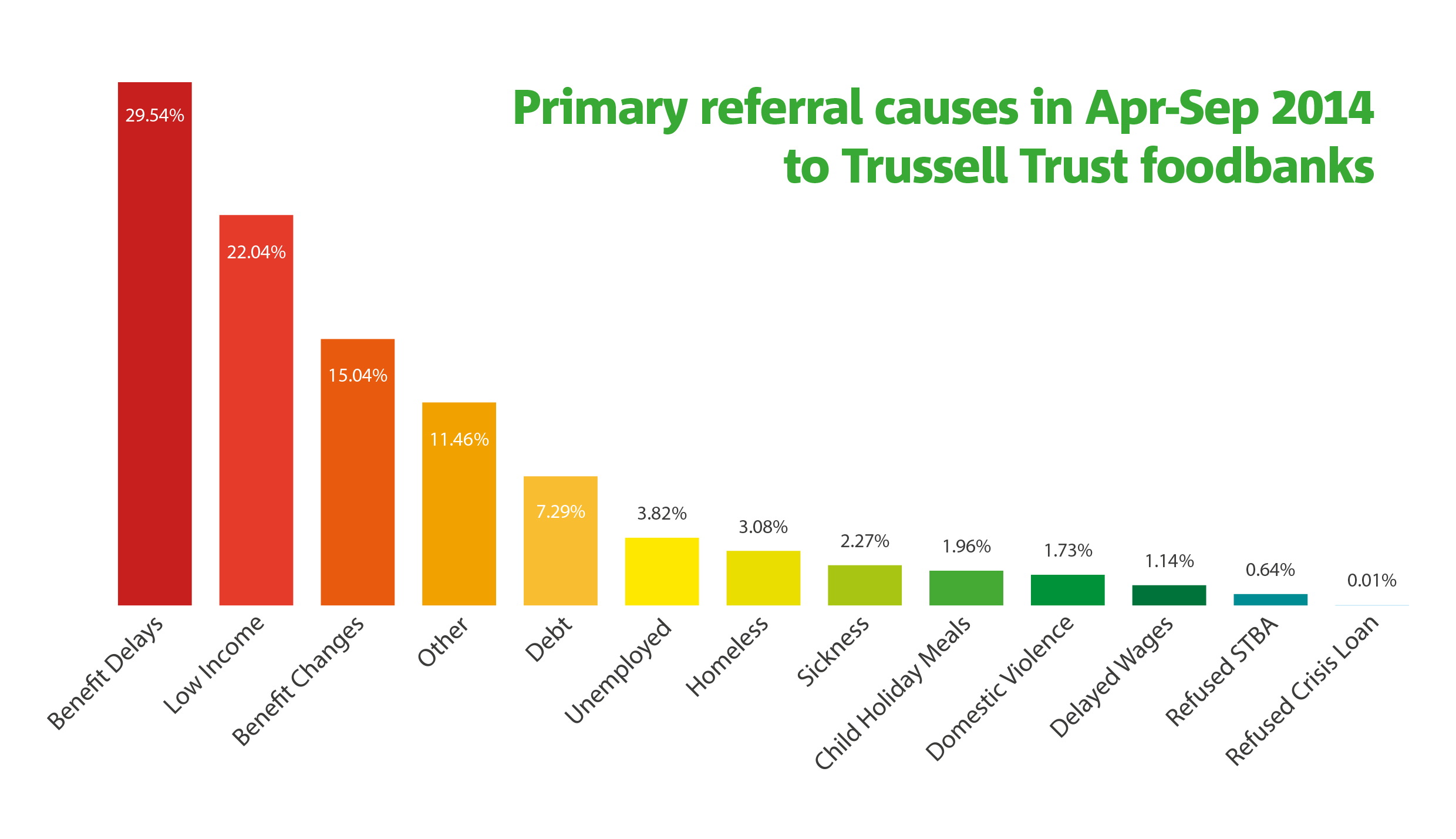
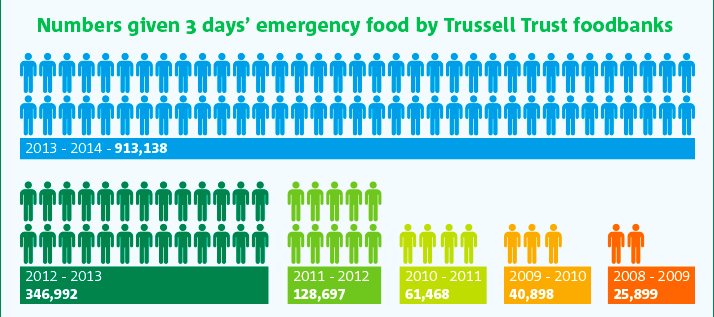
The Trussell Trust are opening foodbanks at a rate of two a week. Their figures reveal that the number  of people they gave emergency food to rose from almost 350,000 in 2012/13 to over double at 900,000 in 20013/14. If this is the tip of the iceberg, as both the figures and Dr Purdam’s research support, then we have a huge problem and it is only going to get worse – it’s estimated that 4.7million people in the UK live in food poverty and the Trussell Trust predict there will be more than one million people using their foodbanks in 2014 alone.

Primary-Referral-Causes-Apr-Sept2014


This is without taking into consideration the many independent foodbanks and other informal sources of food aid that often go undocumented and rely heavily on both community support and donations.


The reasons people turn to foodbanks varies massively and, contrary to what some public figures would have you believe, it’s not because ‘poor people don’t know how to cook.’

While Baroness Jenkin has apologised for her comment, putting it down to ‘stupidly speaking unscripted’, she is not the first to make such a sweeping generalisation – former Conservative Government Health Minister Edwina Currie seemed to blame foodbank users themselves, stating that “they never learn to cook…the moment they’ve got a bit of spare cash they’re off getting another tattoo.”

Katie Hopkins has also jumped on the blame train, comparing foodbank users to ‘cancer patients’ in a recent outspoken rant on social media while Rachel Johnson, sister of the Mayor of London reportedly compared them to animals, saying “Apart from the telly and the cigarettes, they are living like animals.”

The language used to describe foodbank users seems located in a discourse of blame when in reality most people turn to them as a last resort and not as a way to ‘save a few quid’.

Linda from Sale, Manchester was forced to use her local foodbank after being sanctioned by the job centre, having her benefits suspended for several weeks. She says, “I don’t know what I would have done without the foodbank. When the job centre stopped my money for missing an appointment because my daughter was ill I had nowhere else to turn to get food for me and the kids. They were really friendly but the food they gave us was supposed to last for three days but I was sanctioned forScreen Shot 2014-12-10 at 10.20.29 three weeks. Without the food from them and other friends we would have starved.”

Dr Purdam’s research found that in one North West city there were seven Trussell Trust foodbanks and one being set up, with thirty other food aid providers. It’s clear from this that any estimate of food aid use based on Trussell Trust data is likely to be a huge underestimation.

The study also shows that, contrary to public perception, the most common reason given for visiting a foodbank was benefit sanctions, followed by delays in benefit payments – it seems that this underlying issue is a major cause for concern and must be addressed as part of the food crisis debate.

Many of the people Dr Purdam’s research team spoke to described a sense of desperation and need that led to them going to a foodbank, one female visitior said that she “felt like she was begging whilst waiting for her pension credit” and another said she was “willing to turn to prostitution if she did not get help from the foodbank.”

For many people using foodbanks the impact of changes in benefits and entitlement had created a family crisis, this included the Spare Room Supplement or so-called bedroom tax introduced in 2013. Other foodbank users highlighted how recent difficulties and relationship breakdown had contributed to their financial difficulties. Whatever the case it’s clear to see that food poverty is a growing problem in both Manchester and further afield.

A key policy debate resulting from Dr Purdam’s research relates to the role of the state, the voluntary sector and commercial organisations in addressing food poverty in the UK, and the role citizens can have in ensuring their own welfare.
foodbank shutterstock image

Perhaps there is some inevitability about the scale of food insecurity in the UK, given the impact of the economic recession and present welfare reforms but whilst the local authority has provided some funding, food aid is still predominantly reliant on volunteers and donations.

This, along with the ‘normalisation’ of food aid with foodbanks on the high street and food collection points common in supermarkets, are issues that cannot be ignored any longer and will require us all to pull together to make a difference.

Now is also a good time to consider how food waste and reuse is regulated in the UK, compared with other countries – in the UK it’s estimated that 15 million tonnes of food are wasted each year.

With some planning and communication there’s no doubt that some of this waste could be avoided and the government needs to step up and ensure access to adequate food for all. What can be termed as ‘the localization of food welfare’ is actually nothing more than a way of brushing it under the carpet or passing the buck.

Food poverty is an issue that affects us all and needs addressing urgently although sadly it’s clear that the financial vulnerability of certain populations is embedded far beyond the temporary fix of a food parcel.

foodbank-report-header

Project – Sale West Voice Magazine. Launch Edition

Here is a link to my 12 page magazine – Sale West Voice, a hyper-local community magazine.

“Police claims are nothing more than a smear campaign” says Justice for Grainger team

It’s two years since Anthony Grainger was murdered by a police marksman using a sub-machine gun, in March 2012 – unarmed and shot at close range, Anthony was hit in the chest with the bullet entering both his heart and lungs as he sat with two friends in a parked car.

The Justice 4 Grainger Campaign is still going strong

The Justice 4 Grainger Campaign is still going strong

Both the other occupants, along with a third person, were tried and later cleared of plotting a robbery.

The family of Anthony have always maintained his innocence, claiming that he was murdered, in what has been termed ‘The memory stick killing‘ and have set up a campaign, Justice for Grainger, in a bid to clear his name and uncover the truth.

An Independent Police Complaints Commission (IPCC) report into the shooting of Anthony back in 2013 was ‘highly critical’ of Greater Manchester Police, stating that police ‘intelligence’ was flawed when the firearms officer shot the unarmed dad-of-two.

Wesley Ahmed, of the Justice 4 Grainger campaign was horrified when the Manchester Evening News ran a story this week claiming that he and other campaigners had ‘put a £50,000 bounty on the heads of firearms cops‘ – an apparently unsubstantiated claim by Greater Manchester Police.

Wesley totally refutes the 'slanderous' claims made by GMP

Wesley refutes claims made by GMP

In response to these claims Wesley has released the following statement:

“The Justice for Grainger campaign completely refutes the empty allegation by GMP that it is somehow implicated in a threat to the life of GMP firearms officers and condemns the Manchester Evening News for the sensationalist and uncritical coverage of the claims made in court.


“The fact that the police made their baseless claims during a case that has no connection to the killing of Anthony makes their actions even more repugnant.

“The December 9, 2014 edition of the Manchester Evening News carried a front page splash, complete with massive typeset and hard hitting, inflammatory headline: “£50,000 BOUNTY TO KILL POLICE” and underneath “Fears firearms officers could be targeted  by criminal gangs

Anthony Grainger

Anthony Grainger

over deaths of Jordan Begley and Anthony Grainger.”

“The actual article, on page five of the newspaper actually stated that this was only a ‘police claim’ before going on to quote the fraudulent claims of GMP with no critical examination.

“The claim is unsubstantiated and unproven. If this threat was real why have GMP not arrested anyone in the two years since they first made them. It is clearly an attempt to smear the Justice 4 Grainger Campaign and those associated with it, as well as giving the court an excuse for refusing to name the police officers involved in the killing of both Jordan Begley and Anthony Grainger.

“There is no evidence at all, two internal GMP memos between staff that talk of ‘rumour’ do not constitute evidence.

“Our fight is about justice and nothing more.”

Here is a video where Wesley tries to find balance with the MEN story.

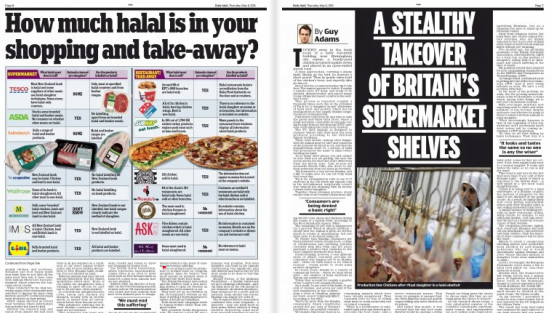
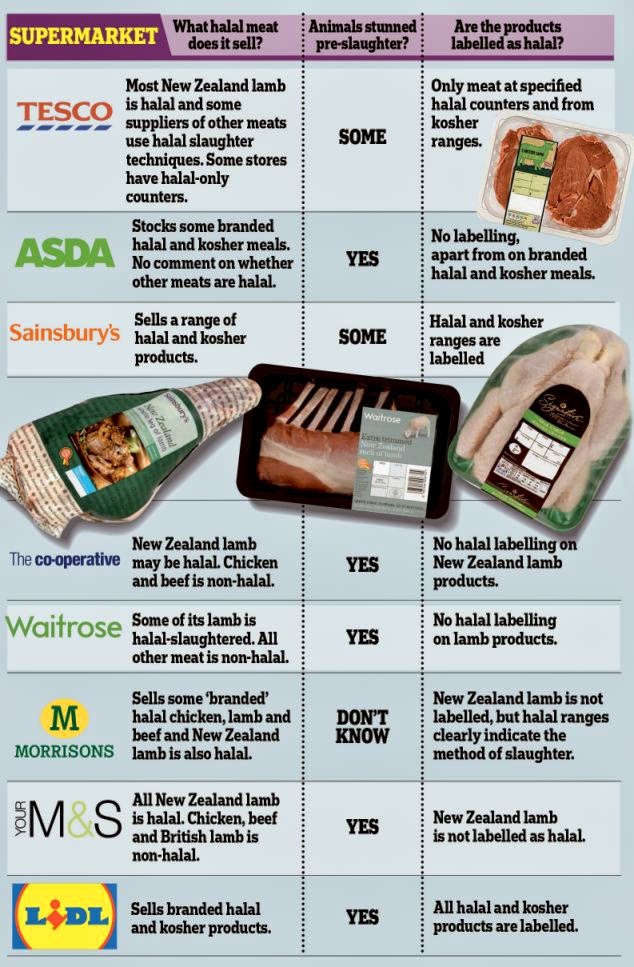
Halal Meat Scandal: What’s the big fuss?

This article was written for Within magazine – The Birthday edition 🙂


10601107_773181516060948_1364743220_n Halal Hysteria has swept across the UK and suddenly we’re having a huge moral panic over how our meat is slaughtered. This has been fuelled by ‘certain’ sections of the media; having realised the threat of imminent terrorism is wearing a little thin, they’re now telling us there’s some kind of sinister plot – inflicting halal meat on innocent, animal loving Brits. Unsurprisingly, both the BNP and EDL have jumped on the anti-halal bandwagon, using the debate as a proxy for the real concern, the presence of a growing Muslim population.

1399572208

More fuel for the halal hysteria fire…


Do you really think the papers are concerned with animal rights? If so, why is the debate not about all forms of slaughter? – The fact it’s only the halal method that’s being discussed is no coincidence.


Why the sudden interest now – if everyone is so worried about how the meat they eat was killed, why have they never asked before?

If The Sun says it's true it must be...

If The Sun says it’s true it must be…

That’s because it wasn’t really a problem, was it? Well, not until The Sun said it was anyway…

So what does halal actually mean? Put simply it’s like this – The animal must be healthy and uninjured. A relevant prayer is recited whilst the animal is slaughtered – using a single cut to the throat with a sharp knife. All blood is then drained from the body.

There’s no nice way to kill an animal in order to eat it, but personally I find this method slightly more palatable than the other ‘non-halal’ methods – the thought of an animal shot with a bolt through the head, or a chicken hung upside down, dipped in electrified water then having its head mechanically removed makes me lose my appetite.

We should have all our meat labeled, with a detailed explanation of how the animal was killed, and then let the consumer decide – in fact, maybe a live feed from the abattoir, relayed on a huge screen directly above the meat fridges is the way forward…

A DMarticle

It’s much easier to find halal meat now, thanks to the ‘scandal’ – silver linings n all that 😉

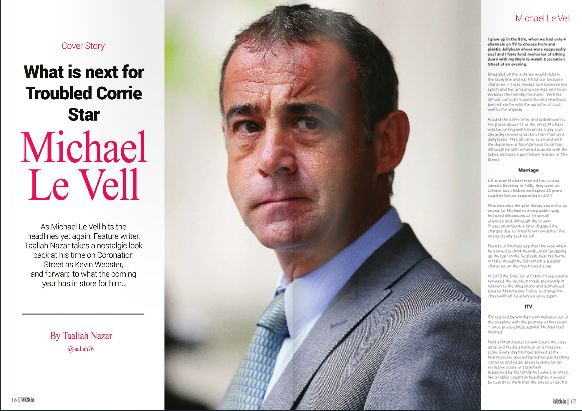
What’s next for troubled Corrie star Michael Le Vell?


As Michael Le Vell hits the headlines yet again, and after spending a day in court during his trial, I take a nostalgic look back at his time on Coronation Street as Kevin Webster, and forward to what the coming year has in store for him…

Michael Le Vell court case

Growing up in the 80’s, when we had only 4 channels on TV to choose from and plastic Jellybean shoes were supposedly cool, I have fond memories of sitting down with my Mum to watch Coronation Street of an evening.

Snuggled on the sofa we would debate the story line and we each had our favourite character – I was always torn between Bet Lynch and her amazing earrings and Kevin Webster, the friendly and *hunky mechanic. *I was 10 at the time, cut me some slack eh.

images-5

Kevin Webster

Around the same time, and unbeknown to me, Michael was becoming well known as a gay icon, allegedly receiving sacks of fan mail on a daily basis. This all came to an end with the departure of his infamous facial hair, although he still remained popular with the ladies and was a permanent feature of The Street.

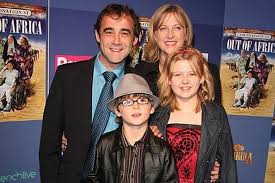
Off screen Michael married his co-star, Janette Beverley in 1986, they went on to have two children and spent 25 years together before separating in 2011.

This was also the year things started to go wrong for Michael in a very public way, he faced allegations of 19 sexual offences and, although the Crown Prosecution Service later dropped the charges due to “insufficient evidence” the stress clearly took its toll.

Friends of Michael say that this was when he started to drink heavily, often “propping up the bar” in the local pub near his home in Hale, though he did remain a popular character on the much loved soap.

images-19

Michael and his family

In 2013 the Director of Public Prosecutions reviewed the decision made previously in relation to the allegations and authorized Greater Manchester Police to charge Michael with all 19 offences once again.

ITV reacted by writing Kevin Webster out of the storyline with the promise of his return – once proceedings against Michael had finished.

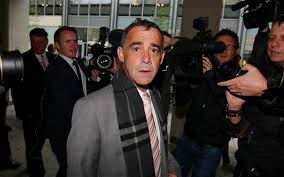
Held at Manchester Crown Court, the case attracted media attention on a massive scale. Every day Michael arrived at the hearing to be greeted by numerous flashing cameras and eager press looking for an exclusive quote or statement.

Michael appeared stressed during the trial

Michael appeared stressed during the trial

Supported by friends he looked like a rabbit caught in headlights; it would be foolish to think that the stress of such a high profile case didn’t affect him in a big way, despite him being eventually found not guilty on all charges.

Leaving court on the day of the verdict, a relieved Michael said he was taking some time out – possibly somewhere abroad, and that he would be back on the cobbles soon, much to the delight of his many supporters.

After a break of six months Michael made his return as Kevin in an explosive storyline that saw him getting into fisticuffs with the neighbours as he arrived with his suitcase in hand. Then he was gone again…

Here is the infamous scene…:)

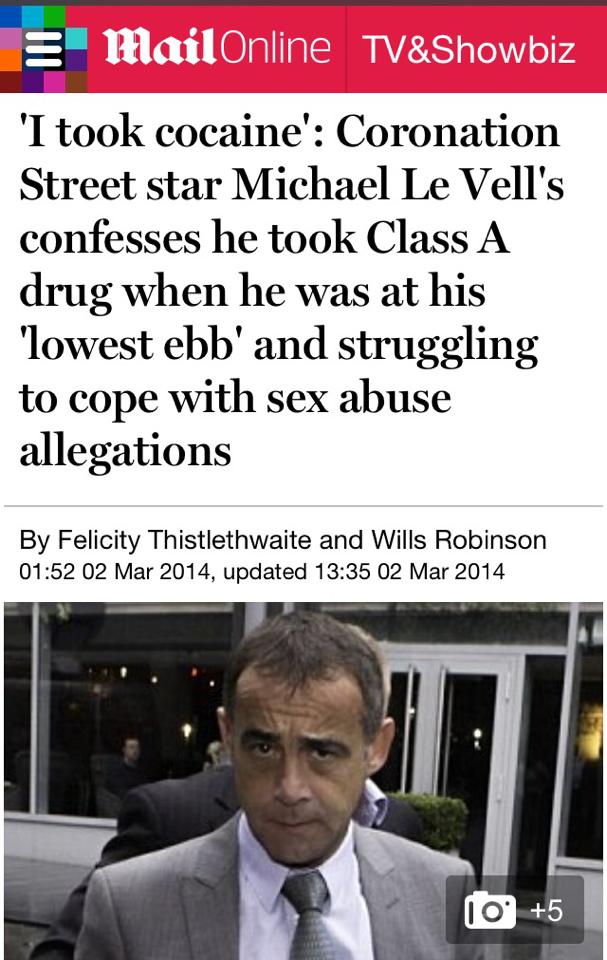
New scandal now surrounds Michael and his personal life, he’s admitted to using Cocaine during the trial, at what he says was his “lowest ebb” and Corrie bosses have given him just three months to turn his life around or risk being written out permanently.

As if this wasn’t enough for the shame-faced star, his ex-girlfriend, Blanca, has added her own fuel to the fire by alleging that Michael “enticed her into having sex with him and another man after he had drunk 12 pints and snorted Cocaine.”

Now, while I am not defending him in any way, I would question why this story has surfaced now, and if it is actually humanly possible to entice anyone to do anything after allegedly consuming so much alcohol then topping it off with some class A drugs?

At the end of the day Michael is a guy who is having a tough time and it would be nice to see him get the space and privacy he needs to get back on track.

Who hasn't made mistakes?

Who hasn’t made mistakes?

Who hasn’t got drunk and made a bad decision or done something they really would rather people didn’t know. He was found innocent of any wrongdoing in a court of law and the rest is little more than tickle tackle.

I reckon the future for Michael is bright, although I’m not sure the same can be said for Kevin, after all, the Corrie scriptwriters are known for their bumpy storylines, who knows what they have in store for his return this time around.

There is speculation that Michael is currently in rehab although this has, so far, been unconfirmed. A friend of the star said: “Michael knows he has to sort his life out and is determined to do that. Coronation Street bosses have been incredibly supportive. They know Mike went through hell with his trial and that the stress has led to problems in his personal life, which have to be resolved. All anyone wants on the show is Mike back, in good health.”

Michael looking relaxed

Michael looking relaxed

Wherever Michael may be at the moment I hope that he is getting the support he so obviously needs and deserves. People are quick to remember the negatives and forget the positive – in my opinion he is not a bad person, as certain media sources would have you believe, more a good person that has made some bad decisions. Only time will tell if he can bounce back again but I really do believe he will.


Michael may have made mistakes and, in hindsight, that moustache was a bit too YMCA, even for the 80’s, but at the end of the day he’s a Manchester bloke that will be remembered long after the Rovers has served its last Hot Pot.


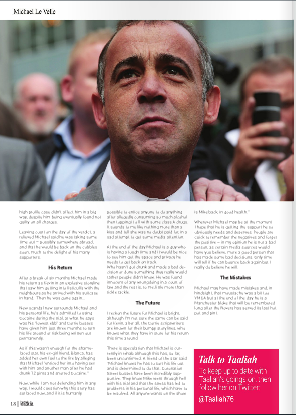
This article first appeared as an exclusive in the April edition of Within Magazine…

Screen Shot 2014-06-04 at 22.39.09 Screen Shot 2014-06-04 at 22.38.44 Screen Shot 2014-06-04 at 22.38.56


18 years on…

The ear-splitting explosion came first, seconds before the shattered glass began to rain down on terrified shoppers on the busy city streets. The sound of fire engines racing across the devastated streets entwined with the screech of burglar alarms as they wailed in protest; a noise that would continue for days, long after the dust had settled and the cleanup had begun.

10367175_734339469945153_7256291433766428925_n


It was a Saturday in June 1996, the day before Fathers Day and Manchester was buzzing. Thousands had taken to the streets to enjoy the sunshine; many were looking forward to the match that afternoon, when England would play Scotland at Wembley, in the Euro 96 football championship.

 Manchester was hosting games in another group and the mood was both cheerful and upbeat. As a gesture of friendship to visiting fans, the Manchester Evening News had placed billboards saying ‘Welcome to Manchester’ in four different languages and the city was alive with people from all over the world.

 Unbeknown to them, IRA bombers had parked a Ford box van containing 3,300 lbs of home made explosives on Corporation Street, outside Marks and Spencer, on double yellow lines, hazard lights flashing.

Within a few minutes an unsuspecting traffic warden slapped a ticket on the windscreen as the driver and his passenger walked away towards Cateaton Street, hoods up and sunglasses on.

 A phone call was then made from the Piccadilly area to an IRA member in Ireland – giving a signal that everything was in place. The two men then left the city in a burgundy Ford Granada, later abandoned in Preston.

Just before 10am, a call was received at Granada Television; it was from the IRA who warned them of the bomb in a coded message. Special Branch confirmed this was a genuine threat and minutes later the evacuation of 80,000 people from the city centre kicked into action.

 By 11.10am the police cordon was a quarter of a mile around the van – the amazing effort to clear the streets would mean that no one would die from the bomb, the biggest seen in peacetime mainland Britain.

The Army’s bomb squad arrived from Liverpool, sending in a robot to break through the van’s window in an attempt to locate and destroy the timer on the passenger seat –instead it triggered the explosion.

They were just seconds from making the bomb safe.

Here is a video of the robot approaching the van and the huge explosion that followed –

Barely a window survived in a half-mile radius of the blast and buildings a mile away were damaged.

images-4

Explosion caught on cctv

A crater measuring 15ft-wide was left where the van had been parked and Greater Manchester’s hospitals were flooded with casualties. Marks and Spencer, being closest to the bomb, was destroyed beyond repair and other notable buildings were badly damaged too. It was the day Manchester was to change forever.

The damage was extreme and far-reaching. Longridge House, home to Royal Insurance was to be demolished and the Arndale bus station, underneath the shopping centre, would never open again.

The Corn Exchange was totally wrecked and although the Royal Exchange Theatre looked like it had escaped the worst, it was later discovered that the bomb had literally raised the roof, putting it back down almost 2inches askew.

The Corn Exchange

The Corn Exchange

The police investigation was headed by Detective Superintendent Bernard Rees and based at Longsight station and they liaised with the head of Special Branch in Manchester. The inquiry was called Operation Cannon, after Cannon Street – close to where the van had parked that terrible day.

With the incident room in full swing, priority was given to tracing the Ford Cargo’s history.

 The registration plate was A214 ACL and, according to the Police National Computer, the van belonged to a man down south, who then told police he’d sold it to a dealer, Arthur Loveridge, who lived in Peterborough.

Detectives went to investigate while others checked motorway traffic cameras, in an attempt to pick up the van’s journey into Manchester.

 They discovered it was driven to London the day before the bomb and had been picked up by camera on the M1. This link with the capital would become significant as the investigation progressed. That same evening the van had headed north, accompanied by the Ford Granada that was used as the getaway vehicle.

 After an appeal for information and some detective work, police discovered telephone traffic between the home of a prime suspect in Ulster and a telephone on the mainland around the time of the bomb, while another call was placed to an IRA ‘quartermaster’ from Manchester just three minutes after the van holding the bomb was parked on June 15.

 Police built up a picture of events that day, as well as confirming the prime suspects.

So why weren’t they arrested?

CPS said they did not believe there was a realistic chance of securing a conviction on the evidence available and, that if the suspect was charged his defence would point out the fact he had been to Manchester after the bomb and, despite the fact that police knew he was in the city, they let him go.

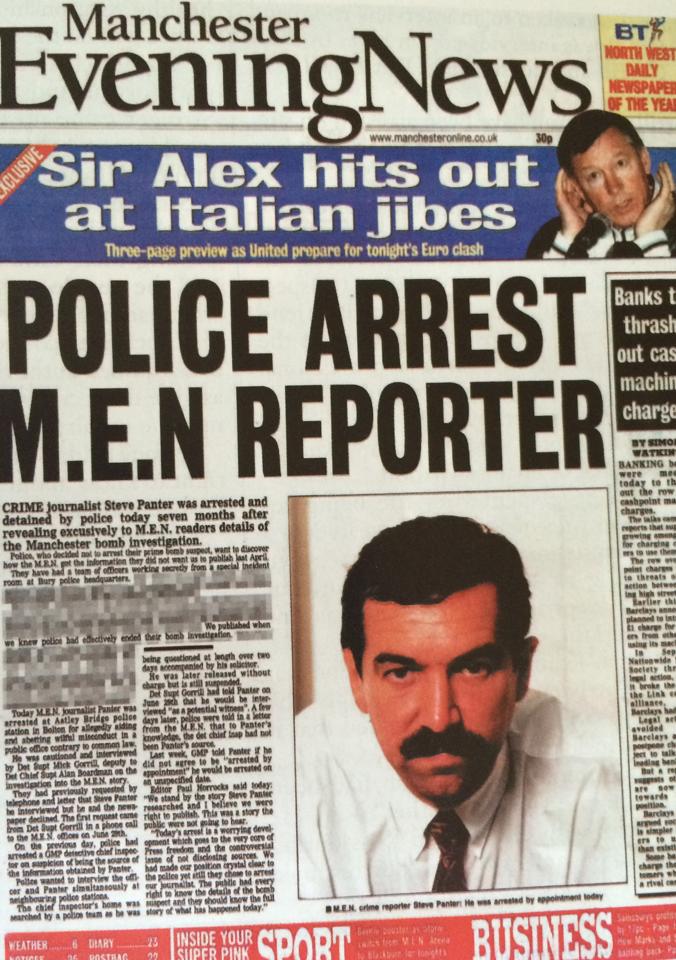
In fact, the only people ever arrested in connection with the bomb were Steve Panter, crime reporter at the MEN who named the suspect, and DCI Gordon Mutch, a senior police officer who faced a harrowing ordeal, accused of leaking confidential information to Steve.

Make of that what you will…

10428770_734977309881369_462049234_n

Police arrested journalist Steve Panter

Steve said that during the summer of 1998 he received a series of anonymous phone calls from a knowledgeable source, offering information about the Manchester bomb. He says that the police had identified suspects in the bombing of ’96 and were not going to arrest any of them for questioning. There was suspicion amongst some of the police connected to the inquiry that politics were involved, and the decision to lock away the investigation file stamped “No Action” was partly to prevent upsetting Northern Ireland, where the plans to get the peace process were finally back on track.

After the bomb Manchester was dramatically rejuvenated in a citywide renaissance that today generates millions of pounds in revenue.

The modern day skyline is very different than before. From the glass icon that is Urbis to the breathtaking Beetham Tower, the flair and passion put into the redesign are clear to see. Ian Simpson is a Manchester lad, and architect – it’s him we have to thank for many of the buildings we see in our contemporary city.

URBIS

URBIS

No doubt pressure was added to the post-bomb development, the Trafford Centre was due to open in 1998 – at a cost of £600 million. The new design had to be modern, and break down the barriers that existed between the wealthy centre and the ‘poor’ areas to the North.

Market Street was where these two worlds merged but there was still the physical barrier of buildings to overcome.

The Printworks as it is today

The Printworks

Pre-bomb, The Printworks, then Maxwell House, was empty and abandoned, Urbis was just a car park and there was nothing but wasteland around the Cathedral.

Manchester city centre today is a thriving, cosmopolitan place to be – full of energy, excitement and pride. In 1995 just 300 people lived in the city, today that figure is over 20,000 and growing.

Some people say that without the bomb Manchester could have suffered the same fate as Sheffield, whose city centre was hit by the challenge of out-of-town shopping malls.

Others disagree with this, pointing out that Leeds and other areas have regenerated perfectly well without a bomb ever being involved.

I’m sure the people caught there that day won’t ever see it as a positive event at all. For me it was a very dark day in my home city, but also one that helped to focus minds on how Manchester could be improved; a tragic catalyst that sparked long overdue change.

 Down but never out indeed…..

This article was originally written for Within Magazine, where it appears as the cover story in the June edition.

Within Magazine - June edition

Within Magazine – June edition

10445971_734339443278489_6066343611011948781_n 10390220_734339459945154_2241281367692343713_n 10367175_734339469945153_7256291433766428925_n

Wild Like the Flowers

Rhymes and Reasons for Every Season

Ummi Homeschools Me

Our journey through homeschooling...for the sake of our Beloved!

ultimatemindsettoday

A great WordPress.com site

Pencil Hub

For the Love of Stationery

unbolt me

the literary asylum

Thoughts, Tales, and Whatnot

the world as I see it through rose-tinted glasses

bookowly

bookowly

Captain’s Log

Life On A Different Plane

ashutosh buch

Random Stuff

Mo Ansar.com

The official website of Mohammed Ansar

Da Masked Avenger

Waiting to strike...

A Buick in the Land of Lexus

fresh hell trumps stale heaven

The Buttry Diary

Steve Buttry, Dearly Departed Husband, Father and Grandfather. Former Director of Student Media, LSU's Manship School of Mass Communication

twinswins

Life is two-riffic with twins!

Road to Brazil 2014

World Cup News, Opinion and Guide

Pride's Purge

an irreverent look at UK politics